For charity shop buyers
Charity shop delivery for something you have bought
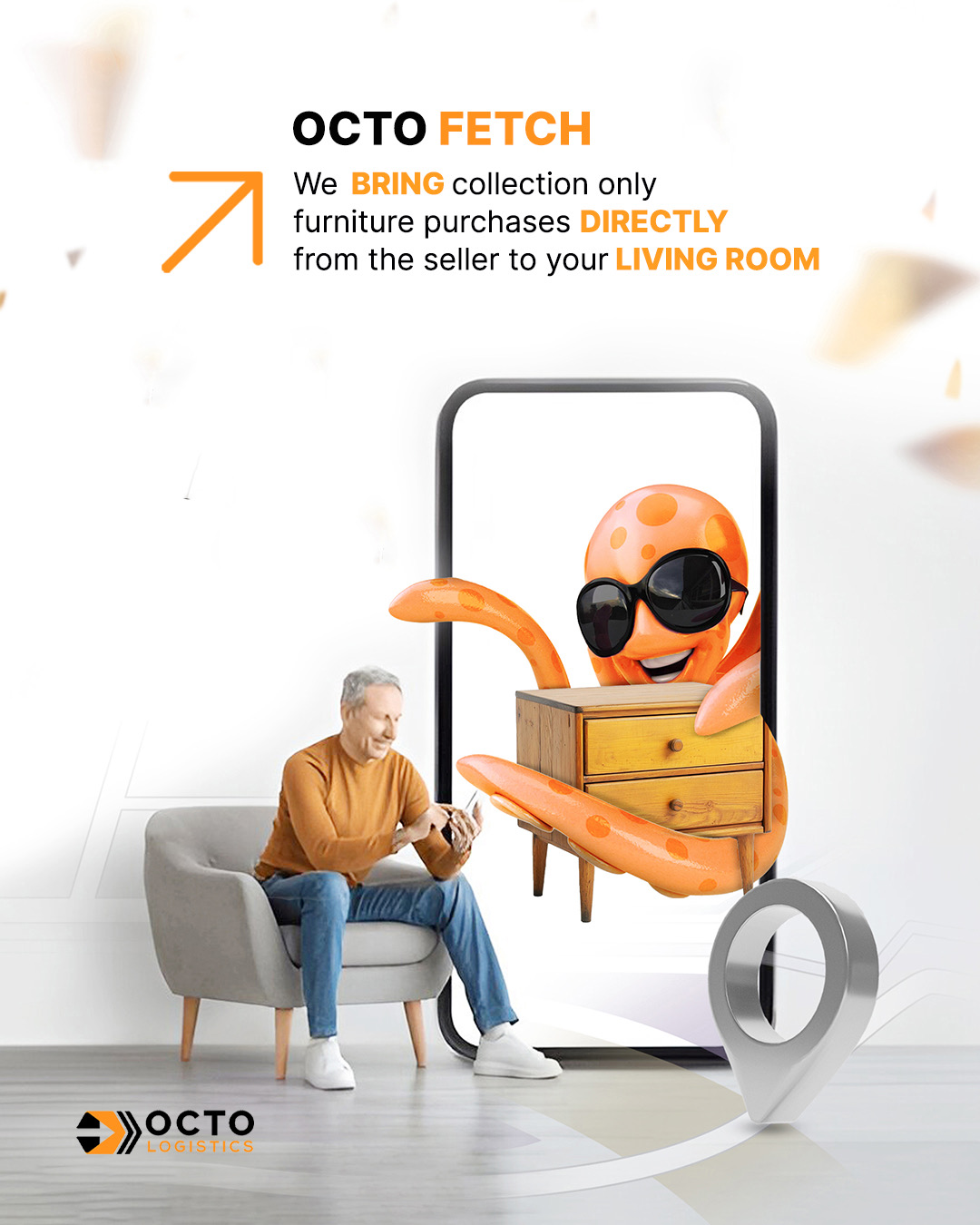
Found the right thing in a charity shop and then discovered they cannot get it to you? OctoFetch collects an item you have bought from the shop and delivers it to your address. Enter the shop's postcode and yours to see your quote and the collection dates we can actually do. One driver collects and delivers your item, so suitable help with loading and unloading must be available where needed.
- For purchases only — we are not a donation or disposal service
- Works when the shop delivers locally only, or not at all
- Your quote from two postcodes before you commit to buying
- You choose the collection date from live route availability
See your price and available collection & delivery dates
This is a delivery service for charity shop purchases
To be completely clear before you read any further: OctoFetch delivers items that customers have bought from charity shops. You pay the shop for the item, we move it from their door to yours, and you pay us for the journey.
We are not a charity donation collection service, we do not offer free furniture collection, and we do not take anything away for disposal or recycling. If you are trying to give something to a charity, or get rid of an item, contact the charity directly — this page cannot help with that and we would rather say so than waste your time.
What we do is straightforward and has limits worth knowing up front. A driver collects your purchase from the shop during their opening hours and delivers it to the address you give us. We do not dismantle, assemble or install anything, we are not a removals firm, and we cannot rely on shop staff to help load — the shop must simply be able to release your purchase to the driver at the agreed time.
Optional extras such as delivery into the home, delivery to a room of your choice and protective packing are shown as separate line items during the quote, so you can see exactly what each one costs before you pay.
When a charity shop cannot get your purchase to you
Charity retail delivery is almost always limited by the shop's own van, volunteers and catchment area. These are the gaps we fill.
The shop does not deliver at all
Plenty of charity shops sell strictly on a take-it-away basis. We collect your paid purchase from the shop and deliver it to your address.
Price a shop collectionThe shop only delivers locally
Local free or low-cost delivery vans usually stop at a few miles or a set postcode list. If you fall outside it, we cover the rest of the journey.
Check your postcodesThe shop is in another town or city
You spotted the item while away, or found it on a charity retailer's online shop. We collect from their address and deliver to yours on a scheduled route.
Price a long-distance collectionThe shop's own delivery date is weeks away
Where a shop can deliver but not soon, you choose from our live collection dates instead of waiting for their next van run.
See available dates
What this page does not cover
This page is about where we collect from, not what type of item you have bought. For item-specific detail and pricing guidance see furniture delivery, sofa delivery, mattress delivery or large item delivery. If you bought from a private seller rather than a shop, read the marketplace delivery guide instead.
Buying from a charity shop in another town or city
Charity shops are a local business with a national supporter base, so the thing you want is often nowhere near you. Distance is a pricing question, not an obstacle.
Get the price before you pay the shop
Charity shop stock is one-off and shops rarely hold items for long, so it is tempting to pay first and think about transport afterwards. Quote the journey first: enter the shop's postcode and yours, and you will know within a minute whether the total still represents a bargain.
Ask how long they will hold it
Most shops will keep a paid item for a short period, and how long decides which of our collection dates you can realistically choose. Get the holding period, and any storage deadline, in writing or by email before you book.
Reserved but not yet paid for
An informal reserve — a name on a label, a verbal promise, a deposit — is not the same as a completed sale, and shops usually will not release goods to a driver on that basis. Complete the purchase with the shop before your collection date arrives.
What to confirm with the charity shop before you book
Charity shops are usually run by a small paid team plus volunteers, and the person who sold you the item may not be there on collection day. Five minutes of confirmation prevents a wasted journey.
- That they will release the item to a third-party courier. Ask explicitly whether a courier collecting on your behalf is acceptable. Some charities require the buyer to attend in person, or need head-office approval, and it is far better to find that out now than at the shop door.
- The receipt, sales slip or collection reference. Ask what proof the driver will be asked for and how you should provide it — a receipt number, a sales slip, a named collection reference, or your OctoFetch booking reference written on their paperwork. Then put that detail in the booking notes.
- Who will be on shift, and their phone number. Give us a name and a contact number for the shop rather than only your own. If the driver arrives and the item cannot be found, a direct number to the shop is what resolves it quickly.
- Their real opening and collection hours. Confirm the days and hours the shop is open, and whether there are times they cannot handle a collection — a Saturday rush, a lunchtime single-staff period, or an early closing day. Collections have to happen inside those hours.
- Where the item is stored right now. Shop floor, stockroom, upstairs, or an off-site unit at a different address? If your purchase lives somewhere other than the shop you bought it in, we need that address, because that is where we will be collecting from.
- The real measurements and weight. Ask a member of staff to measure it rather than estimating from memory. Size, weight and access are what the price is built from, and accurate figures at the quote stage are what keep the price fixed on the day.
Check coverage for the shop's postcode
See your price and available collection & delivery dates
High street access and where our driver can park
Charity shops sit in exactly the places vans find hardest: pedestrianised precincts, narrow high streets, market squares and loading bays with time limits.
Pedestrianised streets and timed access
Many town-centre streets are vehicle-free during trading hours or only open to deliveries before a set time. Ask the shop what applies to their street and tell us in the booking notes — it may decide the time of day the collection can happen.
Loading bays, bus lanes and clearways
Where the nearest legal stopping point is not directly outside the shop, the item has to be carried to the van. Tell us how far that carry is and whether there are steps, kerbs or bollards on the way.
Stockrooms, cellars and upstairs floors
If your purchase is not at street level, say so. Our driver works alone unless you have arranged otherwise, so a cellar staircase or a first-floor stockroom changes what is realistic and needs declaring at the quote stage.
Do not assume shop staff will lift it
Charity shop teams often include volunteers who are not able or permitted to load a heavy item into a van, and we never promise their help. If your purchase needs more than one pair of hands, arrange for someone to be there — we do not provide a second person.
Access details are not small print. Declaring stairs, long carries, restricted streets and parking limits during the quote is exactly what stops the price changing on the day.
If the shop will not release your purchase
It is rare, but it happens, and it is worth knowing where you stand before it does.
The most common reasons
The sale was never completed, the item cannot be found, nobody on shift knows about the arrangement, the shop's policy requires the buyer in person, or the item has been sold again by mistake. Almost all of these are prevented by confirming the arrangement in writing with the shop first.
What our driver will and will not do
The driver will ask for the item using the reference in your booking and will contact the shop number you gave us. They will not negotiate on your behalf, pay the shop, take a different item instead, or wait indefinitely at the kerb.
Where you stand with us and with the shop
A refusal to release is a matter between you and the shop — including any refund of what you paid them. What happens to your OctoFetch booking, including changed dates and cancellations, is set out in our cancellations policy and refunds policy. Tell us as soon as you know something has changed, through your booking link, so there is a written record.
The short version: the shop must have agreed to release the item, accepted third-party collection where their policy requires it, given you the collection details, and be able to make the item available during the booked arrangement.
Booking a charity shop collection, step by step
Four steps, all online, no account needed to see a price.
- 1
Enter the shop's postcode and yours
The shop address is the collection point, your address is the delivery point. Both are checked against live route coverage before you go any further.
- 2
Describe the item and the access
Measurements, weight, which floor it is on at the shop, and any street or parking restriction. Accurate detail here is what fixes the price.
- 3
Add the shop's collection details
Shop trading name, a staff contact number, and the receipt or collection reference they told you the driver should quote.
- 4
Pick a date inside their opening hours
Choose from live collection dates, pay for the booking, and share your booking reference with the shop so you are both working from the same arrangement.
After you book
You get a booking reference, a confirmation and a link showing the current status of the booking. Every change goes through that link, so there is a written record. Lost it? Resend your booking link.
What we do not do, stated plainly
So there is no misunderstanding on the day at either end of the journey.
No donations, no free collection, no disposal
We only move items a customer has bought. We do not collect goods for a charity, we do not clear houses, and we do not take anything away to be scrapped or recycled.
One driver, not a two-person crew
OctoFetch is a driver-led courier service. There is no two-person delivery and no white glove service, so somebody needs to be able to help at each end where an item needs it.
No assembly, dismantling or installation
Items travel as they are. We do not take furniture apart, put it back together, or install or disconnect anything, including appliances.
Not every item is accepted
Weight, size and safety limits apply, and some items are restricted outright. Check our acceptable use policy before you buy something unusual.
Charity shop delivery FAQs
What charity shop buyers ask most before booking a courier to collect a purchase.
Related pages
- Instant delivery quoteTwo postcodes, your item, your quote and live route dates.
- Second-hand shop deliveryBought from a second-hand shop, dealer, warehouse or clearance outlet that is collection only? OctoFetch collects from their premises and delivers to you, with your quote based on the details you supply.
- Furniture deliveryFurniture, appliance and marketplace-item delivery where routes are available.
- Large item deliveryUK large item courier for single bulky and heavy items too big for a parcel network.
- Marketplace delivery guideBuying collection-only on Facebook, eBay or Gumtree? Start here.